Why Most Weekly Team Updates Fail (And the Simple Framework That Fixes Them)
Most weekly update meetings don’t fail because of people—they fail because there’s no structure. Here’s a simple four-block framework that turns updates into decisions.
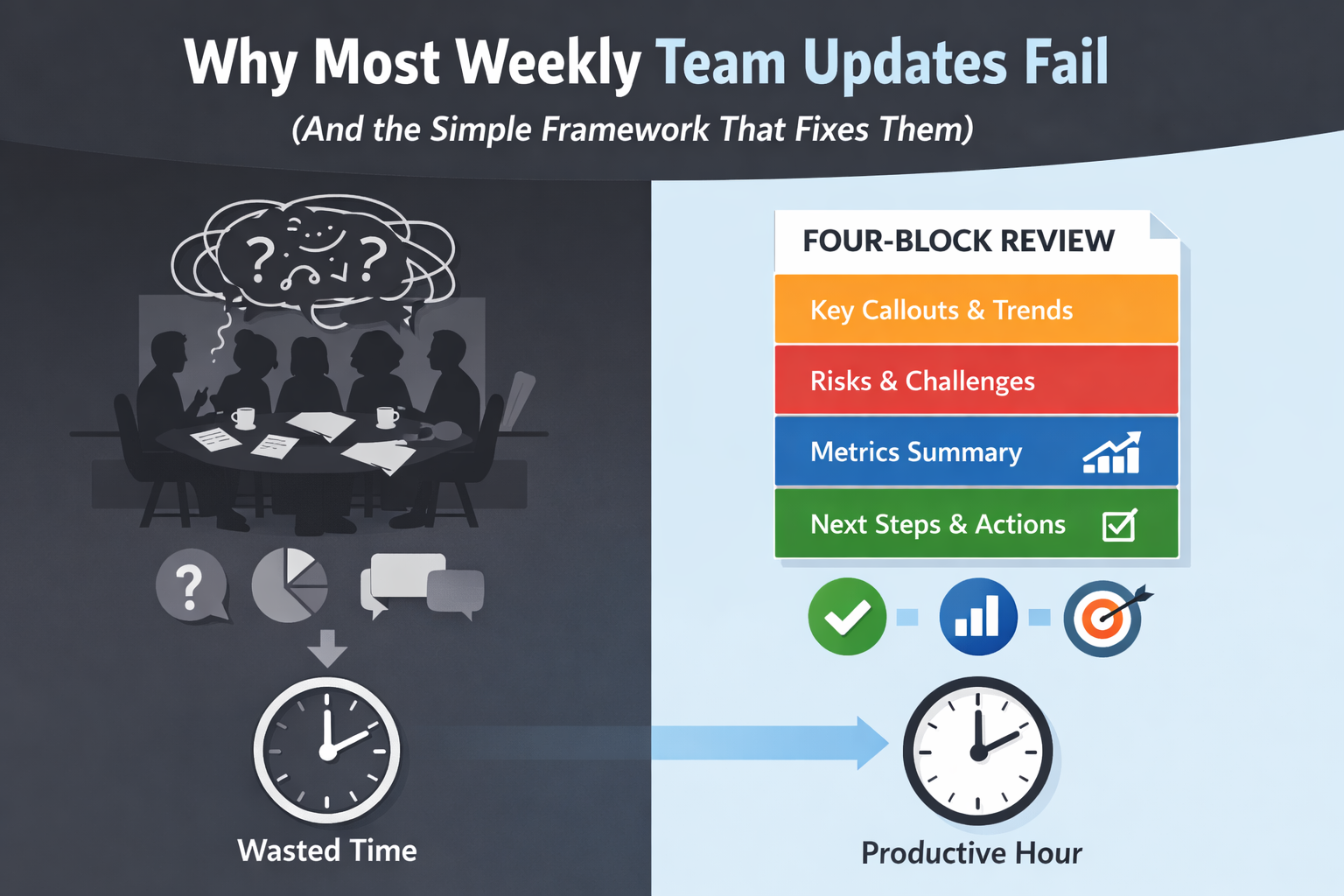
Why Most Weekly Team Updates Fail (And the Simple Framework That Fixes Them)
Let's be honest.
Most weekly team update meetings are a waste of time.
They drag on. They're confusing. And when they end, nothing meaningful has actually been decided.
If that sounds familiar, you're not alone. The good news? This isn't a people problem. It's a systems problem - and it's fixable.
Today, I want to walk you through a simple, powerful framework that can turn those dreaded weekly updates into one of the most productive hours of your week.
We've All Been in That Meeting
Think about your team's last weekly update.
Was it a sharp, strategic conversation that led to decisions and clarity?
Or was it a round-robin of people talking about what they did last week - with no real outcomes?
If you're nodding, you're in good company. Most teams don't struggle because they lack effort or intelligence. They struggle because their updates lack structure.
The Real Problem: No Structure, No Signal
So why do weekly updates feel so unproductive?
The answer is simple: there's no format.
Without a clear structure or rules of the road, meetings devolve into a messy mix of stories, random stats, and half-formed opinions. That wastes time - and worse, it makes it nearly impossible to use data to drive smart decisions.
What teams need isn't more discussion.
They need a repeatable system that creates clarity, consistency, and focus.
The Four-Block Business Review
To fix the chaos, I use what I call the Four-Block Business Review.
Think of it as a template for every single update. Its job is simple: give everyone a clear, concise snapshot of progress, challenges, and priorities - without the noise.
Why does it work so well?
Because structure forces clarity.
- It replaces guesswork with clear assessments
- It puts data at the center of the conversation
- It aligns the team around what actually matters
Let's break it down.
Block 1: Key Callouts & Trends
This is your highlight reel.
Capture recent wins, key learnings, and emerging trends. The goal isn't to celebrate everything - it's to surface what's most important and spread that context across the team.
This block answers one simple question:
What should everyone know right now?
Block 2: Risks, Issues & Challenges
This is where proactive transparency lives.
List your risks and challenges - but don't stop there. For each issue, outline the specific steps you're taking to address it.
That shift matters.
It turns vague problems into concrete plans and signals ownership instead of anxiety.
Block 3: Metrics Summary
This is the data-driven heart of the update.
Present your key KPIs. Call out what's up, what's down, and — most importantly — why.
Numbers tell a story. Your job is to narrate it.
Block 4: Upcoming Activities & Improvements
Now we look forward.
List planned actions, improvements, and deadlines. But this is not just a to-do list. Every item should connect back to a larger business goal.
When people understand why the work matters, execution improves.
Structure Isn't Enough—Clarity in Writing Matters
Here's the truth: even the best framework fails if the writing inside it is vague.
Two rules make all the difference.
The Rule of Four
Your opening summary should never exceed four lines. This forces you to distill what actually matters.
Be Relentlessly Specific
Don't write:
Revenue grew this month.
Write:
Revenue grew 20% to $100,000 month-over-month.
Facts replace feelings. Clarity replaces fluff.
Write for the reader. Use active voice. Cut filler. Format consistently.
How to Run the Perfect Review Meeting
Before you ever hit "Join," run this checklist:
- No blank sections - every block must be filled
- Share the document at least 30 minutes before the meeting
- Let the document do the presenting
- Confirm everyone has reviewed it
- Move block by block- no jumping around
- End with clear action items, owners, and deadlines
That's how conversations turn into commitments.
The Question That Really Matters
So let me leave you with this:
If you implemented the Four-Block Review tomorrow, what blind spot would it surface for your team?
Missing metrics?
Unspoken risks?
A gap between daily tasks and big-picture goals?
Whatever the answer is- that's where the real value lives.
And once you see it, you can't unsee it.